

Yes, there are monkeys in Mexico, but only in the tropical rainforests of the southern states, mostly Chiapas, Tabasco, Veracruz, Quintana Roo, Oaxaca, and Campeche, and the two species travelers can realistically see in the wild are spider monkeys and howler monkeys. Miss that geography and a traveler ends up looking in all the wrong places, or worse, mistaking a food-conditioned resort monkey for a healthy wild troop. The traveler who knows where to go matches a sighting to a trip already on the calendar. This is that map, plus the honest part most pages leave out about what a monkey near a resort balcony actually means.
Yes, There Are Monkeys in Mexico: The Short Answer
Yes. Wild monkeys in Mexico are real, but the range is narrow. They live in the country’s tropical south, in states like Chiapas, Tabasco, Veracruz, Quintana Roo, and Campeche, where the rainforest still stands. Two species matter to a traveler: the spider monkey, high and fast in the canopy, and the howler monkey, the one heard roaring at dawn near the ruins. A trip that touches those southern states or the Yucatán puts a sighting on the table. A trip staying in Mexico City or heading north does not.
Where Monkeys Live in Mexico (And Where They Don’t)
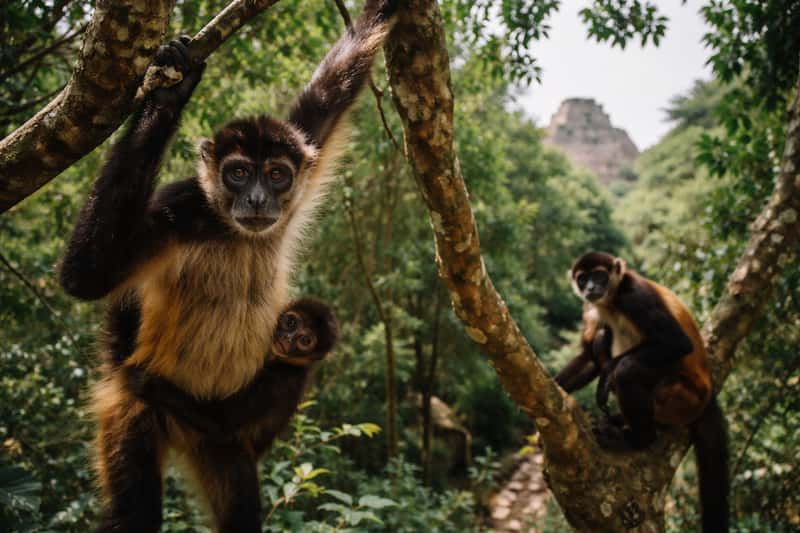
The single most common wrong assumption is that monkeys roam all of Mexico. They don’t. Getting the region right before booking anything saves a wasted detour.
The North-vs-South Distribution, Plainly
Monkey range tracks the tropical rainforest belt, and that belt sits in the south and along the Gulf-side jungle. There are no wild monkeys in Mexico City, no monkeys in Baja, none around Monterrey, and none on the central plateau. Picture a rough line: the Yucatán Peninsula and the Gulf states hold populations, everything to the north does not. The animals themselves are a southern story.
Which States Hold Wild Populations
The confirmed states are Veracruz, Oaxaca, Chiapas, Tabasco, Yucatán, Quintana Roo, and Campeche. That list is not random. It maps almost exactly onto where the rainforest survives, which happens to be where the ruins travelers already want to see sit. The overlap is the whole reason a monkey sighting fits neatly into a trip that is likely half-planned already.
The Two Wild Species You Can Actually See
Two native groups account for nearly every legitimate wild sighting. Learning to tell them apart before a trip means knowing what’s in view instead of guessing.
Mexican Spider Monkey
The Mexican spider monkey has long limbs, no thumbs, and stays high in the canopy, moving fast and often in fragmented small groups. Travelers spot them by the shaking branches more than the animal itself. The species carries an endangered conservation status, so a clear sighting is a privilege, not a guarantee. Their preference for intact, tall forest is exactly why fragmented habitat hurts them so fast, and the scientific detail on their range and biology is worth reading for background before a trip.
Mantled Howler Monkey
The mantled howler is heavier, slower, and unmistakable by sound. That deep, guttural call carries for over a mile and lands at dawn and dusk, which means a troop is heard long before it’s seen. That’s why howlers are the species most travelers encounter at Palenque: walk the ruins at opening time and the jungle roars back. Locate the sound, look up, and there they are.
State-by-State: Where to See Monkeys in Mexico
This is the part to act on. Match a state to the trip being planned, and note which species shows up where.
Chiapas and Tabasco
- Palenque ruins: howlers at dawn, heard before seen.
- Yaxchilán, reachable by boat on the Usumacinta: howlers and spider monkeys in the river-corridor jungle.
- Jungle corridors near the Usumacinta: both species, best with a guide.
One honest flag: Tabasco and Chiapas were the center of the 2024 die-off, which shapes what a traveler will actually see today.
Quintana Roo and the Yucatán
- Punta Laguna (Otoch Ma’ax Yetel Kooh), near Cobá: the reliable spot for spider monkeys, community-run.
- Calakmul in Campeche: both spider and howler monkeys inside a vast biosphere reserve.
This is the cluster that answers the crowd searching for monkeys in Cancun Mexico. The wild animals aren’t at the resort; they’re an inland drive away.
Veracruz and Oaxaca
- Catemaco area and the Los Tuxtlas biosphere, Veracruz: both species, quieter than the Yucatán circuit.
- Oaxaca’s southern forests: scattered populations, best for travelers already on the Gulf side.
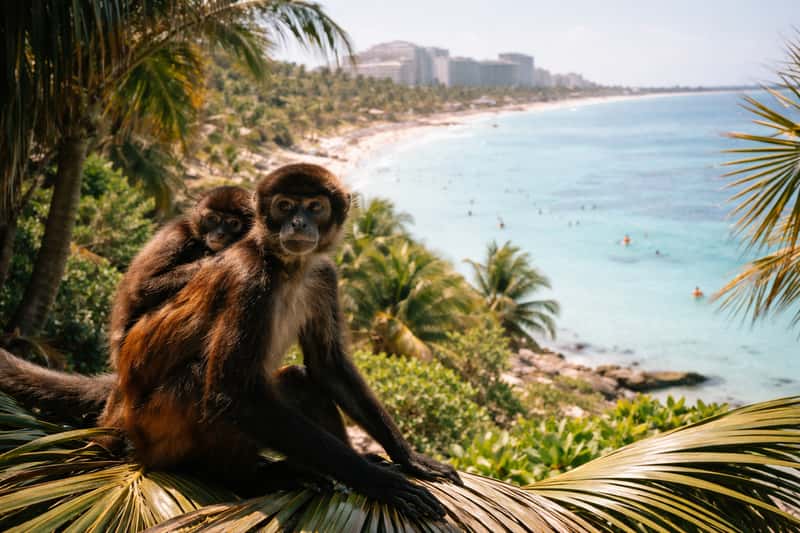
Monkeys in Cancun and the Riviera Maya: What’s Actually Going On
Wild monkeys do live in Quintana Roo, so the question of are there monkeys in Cancun Mexico has a yes buried in it, but not the yes most people want. The troop swinging through resort landscaping is a different animal, sometimes literally, from a wild troop in Calakmul.
Resort Monkeys vs. Wild Monkeys
Some monkeys on resort grounds are wild animals pulled in by easy food and shrinking forest. Others are captive or semi-tame setups run for photos. Either way, a balcony sighting is not the same as seeing a healthy wild troop foraging in intact canopy. One is a stressed animal cutting corners to survive; the other is the real thing.
The Inland Spots Worth the Drive
Travelers based in the Riviera Maya do better to point the rental car at Punta Laguna near Cobá or make the longer haul to Calakmul instead of waiting on a balcony that may never deliver. The drive is where the whole wildlife-sighting logic pays off for the most-searched region in the country.
Why Sightings Are Rising (And Why That’s Bad)
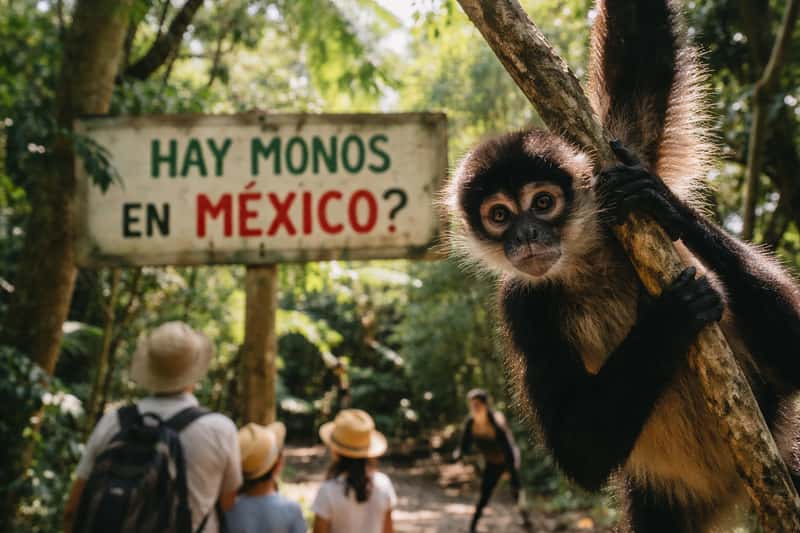
In 2024, a brutal heatwave killed 147 monkeys in Tabasco and Chiapas (The New York Times, 2024). Scientists reported they still didn’t know the exact cause, but pointed to extreme heat layered on fires, deforestation, and logging that stripped away shade, water, and food. So when locals and travelers notice more monkeys near roads, towns, and resorts, that’s often not good news.
What Habitat Loss Means for Sightings
Here’s the counterintuitive part. Fragmented forest pushes monkeys out of the canopy and into human spaces looking for anything to eat. Easier sightings can mean a population under pressure, not a booming one. Every roadside or resort monkey is a signal to tread carefully, not a photo op. The animal near the parking lot is usually there because its forest is failing.
How to See Them the Right Way
The ethical version is simple, and it comes down to a short list of rules travelers can follow:
- Protected reserves and licensed eco-tours beat roadside handlers.
- Distance and quiet keep the animals calm.
- No one should feed them anything.
- Hold-a-monkey and monkey-on-the-shoulder experiences are off the list.
Those four rules mean healthier animals and a smaller mark left behind. The easiest sighting is usually the least healthy one, and the reserve that takes a little effort to reach is the one worth supporting. Planning the trip around Punta Laguna or Calakmul, keeping a respectful distance, is how a traveler sees the real thing.
Why Feeding Monkeys on a Balcony Harms Them
Human food and habituation make spider monkeys dependent, aggressive, and sick, and pull them out of the forest they actually need to survive. A monkey that learns a balcony has bananas stops foraging, starts raiding, and eventually gets injured, relocated, or worse. Feeding a balcony monkey is a problem dressed up as a kindness. The fruit should stay put away.
Booking a Sighting That Helps, Not Hurts
Community-run reserves like Punta Laguna and licensed guides at Calakmul are the way to go. The entry fees there fund the ranger patrols and habitat protection that keep these populations alive, so where the money goes matters as much as where a traveler stands to watch. Seeing monkeys in the Yucatan for years to come depends on that version, the one that keeps them there.
FAQs about are there monkeys in Mexico
Are there monkeys in Mexico?
Yes. Wild monkeys live in the tropical rainforests of southern Mexico, specifically Chiapas, Tabasco, Veracruz, Oaxaca, Quintana Roo, Yucatán, and Campeche. The two native species are spider monkeys and howler monkeys.
Are there monkeys in Cancun Mexico?
Not in Cancún itself in any wild, thriving sense. Wild monkeys live inland in Quintana Roo, and the best nearby spot is Punta Laguna near Cobá. Monkeys seen on resort grounds are usually food-conditioned or captive.
What kinds of monkeys live in Mexico?
Two native groups: the spider monkey (including the endangered Mexican spider monkey) and the mantled howler monkey. Spider monkeys are fast and high in the canopy; howlers are heavier and known for their deep dawn-and-dusk calls.
Where can travelers see monkeys in Mexico?
Palenque and Yaxchilán in Chiapas for howlers, Punta Laguna near Cobá for spider monkeys, Calakmul in Campeche for both, and the Los Tuxtlas biosphere in Veracruz. Protected reserves give the most reliable ethical sightings.
Are spider monkeys native to Mexico?
Yes. The Mexican spider monkey is native to Mexico’s tropical south and parts of Central America. It’s classified as endangered, so sightings in the wild are increasingly rare and worth protecting.
Are the monkeys in Mexico dangerous?
Wild monkeys generally avoid people and pose little threat when given distance. Food-conditioned monkeys near resorts and roadsides can become aggressive, which is one more reason no one should feed them.
Why were monkeys dying in Mexico in 2024?
A severe heatwave killed 147 monkeys in Tabasco and Chiapas in 2024. Scientists suspected extreme heat combined with fires, deforestation, and logging that reduced the shade, water, and food the animals depend on.
Do monkeys live in northern Mexico?
No. There are no wild monkeys in Mexico City, Baja, Monterrey, or the northern desert and central plateau. Their range is limited to the tropical rainforest belt of the southern and Gulf-side states.
Can travelers see monkeys at Mexican ruins?
Often, yes. Palenque and Yaxchilán are known for howler monkeys heard at dawn, and Calakmul sits inside a biosphere reserve with both species. Arriving early raises the odds considerably.
Is it ethical to feed monkeys on a balcony?
No. Feeding makes monkeys dependent, aggressive, and sick, and pulls them out of the forest they need. Community-run reserves and licensed guides are the ethical choice, along with keeping a distance and never offering human food.