

To find the halfway point between two cities, drop both cities into a midpoint tool, let it calculate the center, then snap that center to the nearest real town with a parking lot and a decent diner. That’s the whole method, and it takes about ninety seconds. The catch most people miss is that the raw geographic center and the spot where each driver spends equal time are often two different towns once roads and traffic enter the math. Get that distinction right and the “who drives farther” fight disappears.
How to Find the Halfway Point Between Two Cities
To find the halfway point between two cities, drop both cities into a midpoint tool, let it calculate the center, then snap that center to the nearest real town. Most tools define “the middle” one of two ways: the geographic center (pure latitude and longitude math) or the travel-time center (the spot where each driver spends roughly equal minutes). That distinction changes your answer, sometimes by an entire town.
Here’s the fast version:
- Enter city one and city two.
- Choose whether you want equal time or equal distance.
- Read the midpoint plus each driver’s split.
- Slide the result to the nearest town with food, fuel, and parking.
The geographic midpoint is fast but blind to roads. The travel-time midpoint accounts for highways, speed limits, and traffic, which is why it usually wins for a road-trip meetup. Pick the wrong definition and one person ends up on backroads for an extra forty minutes while the map insists it’s even.
Geographic Midpoint vs Travel-Time Midpoint
The geographic midpoint is raw coordinate math: average the two latitudes and longitudes, drop a pin. The travel-time midpoint is the spot where each driver clocks roughly equal minutes behind the wheel. These can land in different towns the moment one party gets a clean interstate and the other gets a two-lane county road. The halfway point that feels fair is where both people spend equal time getting there, not the center of a map. For most meetups, travel time is the number that decides who feels cheated.
Halfway by Distance vs Halfway by Time
Halfway is a choice, not a fixed dot. Equal miles and equal minutes produce different results, and equal time tends to feel fairer when one side faces highways and the other faces backroads. A 60-mile stretch of stop-and-go can eat the same hour as 90 miles of open freeway. Quick rule: if both drivers are on similar road types, distance is fine. If one is on highway and the other on rural roads, choose time. For more on why the route you see isn’t always the route most people take, see our guide to comparing driving routes between two points.
Use a Free Halfway Point Tool
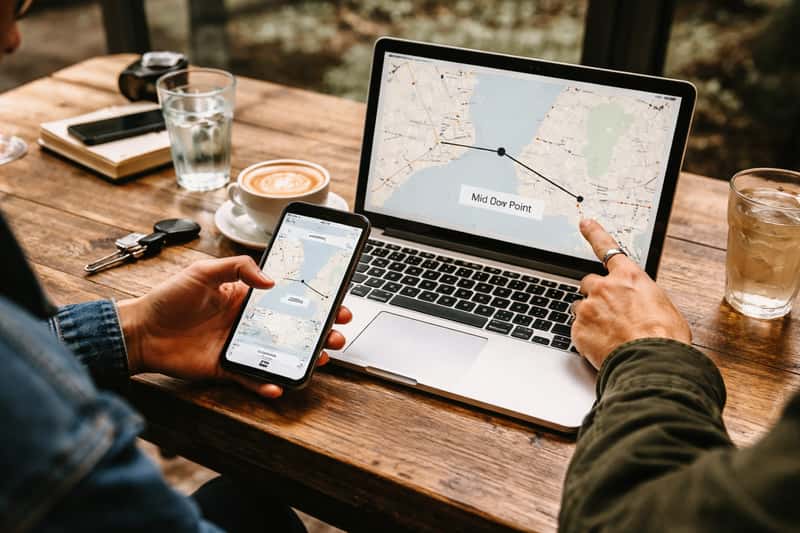
A free midpoint finder does the math and the venue search in one pass. The steps are short:
- Enter city one (full address or ZIP for a tighter result).
- Enter city two.
- Pick time or distance as your fairness metric.
- Read the midpoint and each driver’s distance and drive time.
- Browse nearby venues, then lock in a real spot.
Tools like MeetWays and Mappr will also surface cafes, restaurants, and parks near the center, which turns a coordinate into a plan. Entering full addresses or ZIP codes returns a sharper midpoint than city names alone, because “Chicago” and “a specific Chicago suburb” can sit thirty miles apart.
What to Enter for an Accurate Result
Input quality decides everything. Vague inputs push the midpoint off by miles, and a midpoint off by miles can mean the wrong town entirely. Your options:
- Full street addresses: the most accurate, best for local meetups.
- ZIP codes: good when you want privacy but still want precision.
- Coordinates: useful for remote or rural starting points with no clear address.
- City names: fine for a rough read or long-distance flights, weak for a lunch meetup.
Find the Halfway Point on Google Maps
If you’d rather not open a separate tool, Google Maps does it manually. Get directions between your two cities, click to add a stop partway along the route, then drag that stop until both legs show similar drive times. When the two numbers match, you’ve found your travel-time midpoint. Because Maps shows live traffic, the drive times shift with conditions, which is exactly what you want when fairness depends on minutes rather than miles. Upside: free and traffic-aware. Downside: manual, approximate, and a little fiddly.
The Measure Distance Trick
For a quick straight-line sanity check, right-click your starting city, choose “Measure distance,” then click the second city. The number it gives you is as-the-crow-flies, not drivable, so use it to ballpark whether a midpoint is even worth calculating. It’s useless for drive-time fairness, but handy when you just want to know if two cities are an hour apart or six.
Snap the Midpoint to a Real Meeting Town
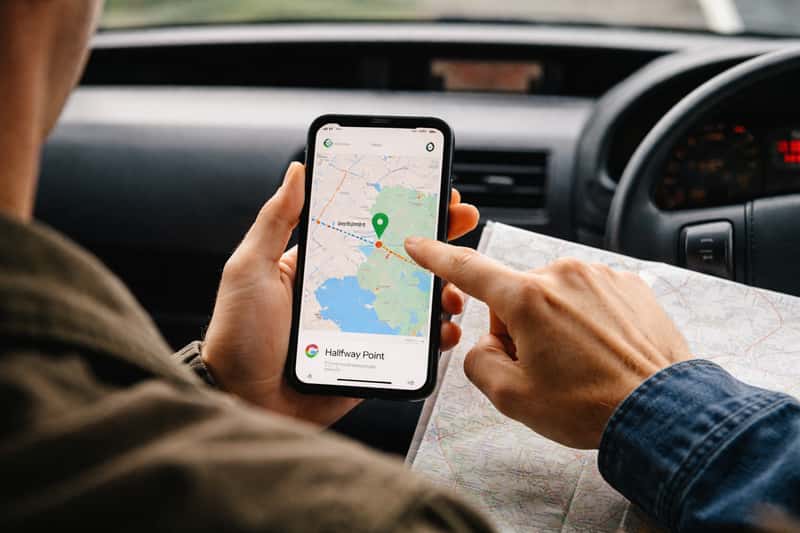
Here’s the gap most tools gloss over: the raw GPS midpoint often lands in a soybean field or on a stretch of interstate with no exit for twelve miles. Nobody meets there. The fix is to slide the point to the nearest town that has food, fuel, and parking. A midpoint finder that lists venues makes this easy; a coordinate tool makes you do it by eye. Either way, the goal is the same, turning a number into a place two people will actually agree on. For a worked example of the same midpoint-to-real-place logic on a fixed route, see our distance breakdown for a long-haul drive.
What to Check Before You Pick the Spot
Run this checklist before you commit:
- Highway access within a few minutes of the exit.
- At least one or two real restaurants, not just a vending machine.
- Gas within a few miles for the drive home.
- Easy, free parking that fits both vehicles.
- Opening hours that match your meet time.
- Seasonal closures and early-closing small towns (a lot of rural diners shut by 8pm or close Mondays entirely).
Make the Split Feel Fair to Both Drivers
Put both drivers side by side and the fairness becomes visible. A clean 50/50 on the map can still feel lopsided if one side hits tolls or rush-hour traffic.
| Driver | Distance | Drive time | Road type |
|---|---|---|---|
| Driver A | 95 mi | 1 hr 35 min | Interstate |
| Driver B | 72 mi | 1 hr 38 min | County roads |
Driver B covers 23 fewer miles but spends two minutes longer. That’s a fair split by time and an unfair-looking one by distance. Show the numbers and the argument ends.
When to Skew the Midpoint on Purpose
You can nudge the meeting spot off the mathematical center for a good reason. Three examples:
- Give the city driver a shorter distance but the same time, since they’re already fighting traffic to get out of town.
- Push toward a safer, better-lit town when one party arrives after dark.
- Shift toward a town with a real attraction so the meetup is worth the drive, not just a parking-lot handoff.
Halfway Points for Different Trip Types
The “right” midpoint shifts with the trip. A romantic weekend wants a town with a good dinner spot and somewhere to walk. A kid-heavy family meetup wants a park, a clean restroom, and a parking lot that fits two minivans. An overnight stop on a long haul wants safe lodging near the highway. Same coordinate, three different filters. Most tools let you search by venue type, so set the filter before you fall in love with a town that has nothing your trip needs.
Overnight Stops on Long Drives
On routes long enough to need a sleep break, like a multi-day cross-country leg, the exact center matters less than a midpoint town with safe lodging near the highway. AAA-style fatigue guidance suggests breaking long drives well before exhaustion sets in, so aim for a town with a clean hotel and gas, even if it’s twenty miles off the perfect center.
Meeting Three or More People
Multi-point midpoint finders take several starting cities and return one central spot plus each person’s drive. They’re built for family reunions and scattered friend groups, often handling two to six locations at once. The payoff is shared burden: instead of one person driving four hours while everyone else drives one, the tool finds the spot that spreads the miles as evenly as the map allows.
Halfway Points for Flights and International Trips
For air travel and cross-border planning, exact addresses matter less, so city-level inputs are fine. Say one person flies from Dallas and the other from Toronto: enter both city names into a geographic midpoint tool and it points you near Chicago, which tells you to compare flights into O’Hare or Midway rather than guess. Use cities, not street addresses, here; the precision you’d want for a lunch meetup is wasted when you’re choosing between two metro areas a hundred miles apart.
Where Halfway Tools Fall Short
Set honest expectations. ETAs drift with traffic, road closures and rural gaps throw off the math, and “halfway” is a strong starting point rather than a promise. Treat the result as a draft, then sanity-check it against real roads. One more thing, on privacy: share the midpoint or the venue, not everyone’s home address. When you’re meeting someone you only know online, use cross streets or a ZIP code as your input instead of your front door, and send the group only the final spot.
Our Take
Skip the back-and-forth and let the tool answer in ninety seconds. Use the time-based split, snap to a town with food and parking, and skew the center on purpose when fairness asks for it. The math is the easy part. Picking a place worth meeting at is the part worth your attention.
FAQs about find halfway point between two cities
How do I find the halfway point between two cities for a road trip?
Enter both cities into a free midpoint tool, choose equal drive time over equal distance, then read each driver’s split. Slide the result to the nearest town with food, fuel, and parking.
Is the halfway point based on distance or travel time?
It can be either, and they often land in different towns. For road trips, travel time usually feels fairer because traffic and road quality can make a shorter-on-paper stretch take just as long.
How do I find the halfway point between two cities on Google Maps?
Get directions between the two cities, add a stop partway along the route, then drag that stop until both legs show similar drive times. It’s free and uses live traffic, but it’s approximate.
Can I find a halfway point between more than two cities?
Yes. Multi-point midpoint finders handle two to six (or more) locations at once and return one central spot plus each person’s drive time, which helps spread the driving burden across a group.
How do I find a fair spot if one person is in a city and the other is rural?
Use the equal-time setting instead of equal-distance. The city driver may cover fewer miles but spend the same minutes thanks to traffic, so a time-based midpoint feels fairer to both.
Can I use coordinates or ZIP codes instead of full addresses?
Yes. ZIP codes work well when you want privacy, and coordinates are best for remote starting points with no clear address. Full addresses give the tightest result for local meetups.
How accurate are midpoint calculators for long cross-country trips?
They’re a strong starting point, not a guarantee. ETAs drift, road closures and rural gaps skew the math, and the longer the route, the more a small percentage error adds up. Sanity-check the result.
How do I find a safe overnight stop halfway on a long drive?
Look for a midpoint town with lodging near a highway exit rather than the exact mathematical center. Prioritize gas, a clean hotel, and well-lit access over hitting the precise middle.
Are there free apps to find the halfway point between two places?
Yes. Several free tools and mobile apps calculate midpoints by time or distance and surface nearby venues. Many run in a browser, and some offer iOS apps for planning on the road.
Can I find a restaurant or hotel exactly halfway between two locations?
Many midpoint tools let you filter by venue type, so you can search for a restaurant, cafe, park, or hotel near the center. Pick the spot from those results instead of accepting a bare coordinate.