

Two people sixty miles apart agree to meet halfway, both punch the same town into their phones, and one shows up forty minutes before the other because their route was open interstate while the other crawled through two-lane mountain passes. That gap is the whole problem, and it’s why a quick midpoint guess costs someone the better part of an hour every time it’s wrong. To meet halfway in any practical sense, you don’t find the center of the map, you find the point where the effort splits fairly, and those two spots can sit a hundred miles apart. The fix is a three-step method: get the straight-line center, snap to the nearest town with parking and food, then check whether driving times actually split even. Below is that method with worked numbers you can copy, so you can name your spot in under five minutes and defend the choice with real figures instead of a guess.
What “Meet Halfway” Actually Means When You’re Planning a Trip
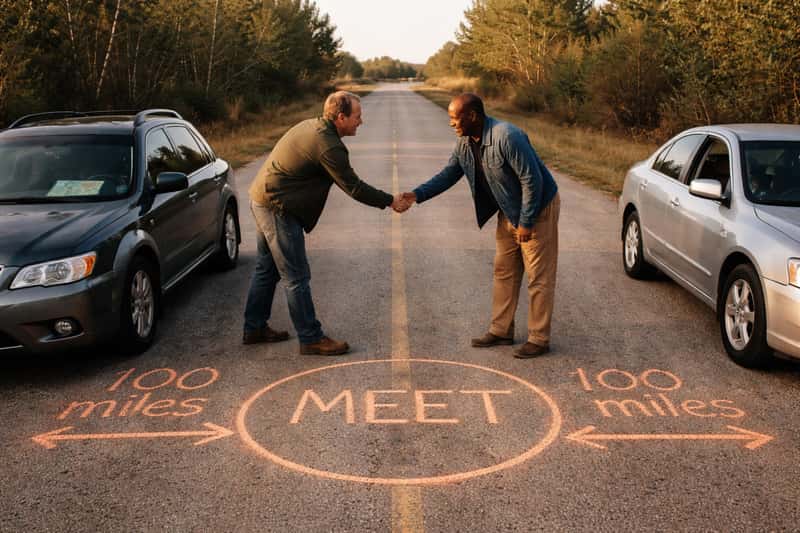
When you want to meet halfway, the spot you’re after is rarely the center of the map. It’s the place that splits the effort fairly between two travelers. Those are two different questions, and you have to pick one before you calculate.
The two competing definitions are the distance midpoint and the drive-time midpoint. The distance midpoint is the geographic center, equal miles from each person. The drive-time midpoint is the spot where both people spend roughly the same minutes behind the wheel. On flat, evenly connected roads they’re close. On lopsided routes they’re not.
You’ll get a repeatable method and a worked example with real numbers a little further down. First, the distinction that flips the answer.
Distance Midpoint vs. Drive-Time Midpoint
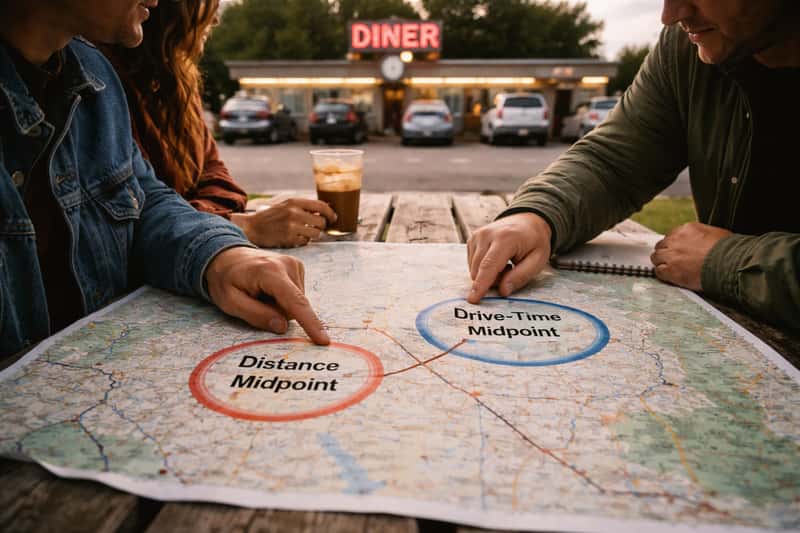
A straight-line midpoint and an equal-time midpoint can sit hundreds of miles apart once you account for highways, bridges, tolls, and traffic. Mileage treats every mile as equal. The road doesn’t. Sixty miles of open interstate moves faster than thirty miles of switchbacks, so equal distance can mean wildly unequal time.
This is the part most people get wrong. The useful midpoint is the one where journey times match, not where the map says the center is. In cities with bridges and uneven road networks, that distinction decides whether one person waits in a parking lot for an hour.
Why the Geographic Center Often Lands in a Field
Plot the exact coordinate halfway between two cities and you’ll often get empty road, a reservoir, or a crossroads with one gas station. The math doesn’t care whether a town exists there. You don’t camp on a coordinate, so you snap to the nearest real place with a bed, parking, and somewhere to sit while you wait.
When Drive Time Beats Distance
If one person runs a clean interstate and the other crawls through mountain passes, equal miles is unfair on its face. Use drive-time matching whenever road conditions are lopsided. The person on the slower road should drive fewer miles to land the same time on the clock.
How to Find Your Halfway Point in Five Minutes
The method is three steps, and it’s repeatable for any pair of cities. Find the straight-line center, snap to the nearest usable town, then confirm the drive-time split.
Step 1: Get the Straight-Line Center
Plot both starting locations on a map and find the midpoint coordinate between them. Most midpoint tools do this in one click. This number is your anchor, not your answer. It tells you which region to look in, nothing more.
Step 2: Snap to the Nearest Real Town
Move from the raw coordinate to the closest place with hotels, parking, and food. Look within a 15 to 20 mile radius of the center point. You want a town that can hold two cars and two people for an hour or a night, not the prettiest dot on the line.
Step 3: Check the Drive-Time Split
Pull both driving times to your candidate town. If one leg runs 40 minutes longer than the other, the spot isn’t fair yet. Nudge the meeting point toward the person driving farther until the two times land within 10 or 15 minutes of each other.
A Worked Example With Real Numbers

Take Chicago and Minneapolis, about 410 miles apart by road. The straight-line center sits near the Wisconsin Dells region. Snap to the nearest real town with lodging and food and you get Wisconsin Dells or Madison, both with hotels, parking, and highway access off I-90 and I-94.
Pull the driving times. Chicago to Wisconsin Dells runs roughly 3 hours. Minneapolis to Wisconsin Dells runs roughly 3 hours 30 minutes. That’s a 30-minute gap, with the Minneapolis traveler driving longer. To even it out, you slide the meeting point 25 to 30 miles toward Minneapolis, landing near Tomah, and both legs settle close to 3 hours 15 minutes each.
Where the Two Methods Disagree
The pure distance midpoint pointed at the Dells. The drive-time-fair point sat farther northwest near Tomah. The two answers differed by about half an hour of driving for one person. You want the drive-time point, not the distance point, because the goal is equal effort, and a 30-minute imbalance is exactly the kind of thing that makes one person feel they got the short end before the trip even starts.
The Decision Factors That Decide the Spot
Once you have two or three candidate towns, you weigh fairness against convenience instead of trusting a single number. Sometimes the most central town has nothing open, and the town 12 miles off-center has parking, a diner, and a hotel. That trade-off is the real decision.
Who’s Willing to Drive Farther
Fairness isn’t always a clean split. If one traveler has more time, a faster route, or cheaper fuel, weight the point toward the other person on purpose. A retiree with an open afternoon can absorb an extra 30 minutes that a parent on a tight school-pickup window can’t.
Cost and Mode of Each Leg
Account for tolls, fuel, and parking before you commit, and check whether one side is driving while the other takes transit or a short flight. A toll-heavy route can cost $15 to $25 one way, which shifts the fair point even when the minutes match.
Decision factors worth listing side by side:
- Driving-time split between the two legs
- Who travels farther and who has more flexibility
- Transport mode for each side: car, transit, or short flight
- Cost per leg: tolls, fuel, parking
- What’s actually open at the meeting point when you arrive
Picking a Town That’s Worth Meeting In
The exact center is useless if it has no parking, no coffee, and nothing to do during the wait. Pick the reachable town with lodging and food over the mathematically pure one. A coordinate doesn’t have a bathroom. A town does.
What a Good Meeting Town Needs
Run every candidate through the same practical filters. The town that clears all five beats the one that’s three miles closer to center.
- Parking that fits both vehicles without a hunt
- A place to eat or grab coffee while one person waits
- Somewhere comfortable to sit if the other leg runs late
- Easy highway access so neither person fights surface streets
- Lodging if the meet turns into an overnight
Meeting Halfway for Groups and Long-Haul Routes
The method extends past two people. With three or more starting points, you’re balancing several drive times at once, and the fair point is the spot that minimizes the longest single leg, not the average. Some midpoint tools handle a whole group rather than just a pair, which saves you from running the math three times by hand.
For multi-country or overland routes, the midpoint stops being a quick meetup and becomes a planned overnight. The same logic that powers any route-comparison logistics question applies here: you want the stop that splits the effort, not just the distance.
Splitting a Long Drive Into Two Days
On a long road trip, the halfway point doubles as your stopover. Pick the town that breaks the total drive time roughly in half and has a bed for the night. A 12-hour drive splits cleanly into two 6-hour days if the right town sits near hour six, with a hotel and food off the highway.
Tools and Manual Workarounds for Finding the Midpoint
Dedicated halfway apps calculate a midpoint and surface points of interest nearby, and many now handle driving, transit, walking, and biking modes. Some claim coverage across more than 120 countries, which matters for cross-border meetups. They’re fast for the first pass.
Google Maps won’t drop a halfway pin natively, but you can fake it. Get the full A-to-B route, find the road segment near the center, drop a pin on a town there, then request directions from each start to that pin and compare the two times. That manual cross-check is worth running even when an app hands you an answer, because tools disagree on distance the same way they do for any A-to-B query. When two sources give you different numbers, pull a third and take the cluster, not the outlier.
Key Takeaways
- Distance midpoint and drive-time midpoint are different answers; the straight-line center often sits far from where actual driving times split evenly.
- The geographic center usually lands on empty road or water, so snap to the nearest town with lodging, food, and highway access.
- Find your spot in three steps: plot the center, move to the closest real town, then compare both driving times and adjust.
- Fairness isn’t always 50-50; weight the point toward whoever has the slower route, less time, or higher fuel cost.
- Pick the reachable town with parking and a café over the mathematically pure coordinate with nothing nearby.
- The method scales: balance multiple drive times for groups, or use the midpoint as a planned overnight stop on long routes.
Run the three steps, compare both drive times, and name the town with real numbers behind it. The same approach powers every route page here, so check the next leg of your trip before you commit.
FAQs about meet halfway
What does it mean to meet halfway when planning a trip?
It means picking a meeting point that splits the effort fairly between two travelers, not the geographic center of the map. The fair point is usually where driving times match, which can sit far from the distance midpoint.
Is the halfway point the same as the geographic midpoint?
No. The geographic midpoint is equal miles from each person, while the practical halfway point is where driving times split evenly. Highways, tolls, and traffic can put those two spots a hundred miles apart.
How do I find a halfway point between two addresses?
Plot both locations to find the straight-line center, snap to the nearest town with hotels and food, then pull both driving times to that town. If one leg runs longer, nudge the point toward the person driving farther.
Can I find a halfway point by driving time instead of miles?
Yes, and you usually should. Compare both driving times to a candidate town and shift the meeting point until the two times land within 10 to 15 minutes. Drive-time matching is fairer when one route is faster than the other.
Does Google Maps have a halfway-point feature?
Not natively. You can work around it by getting the full route, dropping a pin on a town near the center, then requesting directions from each start to that pin and comparing the two driving times.
Can I find a halfway point for more than two people?
Yes. For three or more starting points you balance several drive times at once, aiming to minimize the longest single leg. Several dedicated midpoint tools handle a whole group rather than just two addresses.
How do I choose a halfway spot with restaurants and parking nearby?
Filter candidate towns for parking that fits both cars, a place to eat, comfortable waiting space, and easy highway access. Pick the reachable town that clears those filters over the exact coordinate with nothing around it.
What’s the cheapest way to meet halfway?
List the cost of each leg side by side: tolls, fuel, and parking. A toll-heavy route can add $15 to $25 one way, so weight the meeting point toward the more expensive side to keep total cost balanced.
How do I split a long road trip into two days using the midpoint?
Find the town that breaks the total drive time roughly in half, not the distance, and confirm it has a hotel and food off the highway. A 12-hour drive splits into two 6-hour days if the right stopover sits near hour six.
What’s the best app to find a meeting point halfway?
The strongest tools calculate a midpoint and surface nearby points of interest across driving, transit, walking, and biking modes, with some covering over 120 countries. Whatever you use, cross-check the driving times manually before you commit.